A Church Comes Down, a Shelter Stays Closed, and the Council Goes Looking for Money
Decatur's Oct. 19 meeting split cleanly in two: an hour of residents demanding answers on demolition, homelessness and slum conditions — then twenty minutes of unanimous votes laying groundwork for water, transit and redevelopment that won't pay off for years.
If you only watched the second half of Monday's council meeting, you'd have seen a well-oiled machine: six resolutions, one consent calendar, every vote unanimous, adjourned by 8:30. If you only watched the first half, you'd have seen a city struggling to answer its own residents. Both halves were the same meeting, and the distance between them is the story.
The formal agenda was about the long game — a study of how much water Decatur's wells can safely pump, a $20 million grant request for the transit campus, and the first steps toward two new tax-incentive districts. None of it was controversial. But the public-comment period that preceded it was raw, and it circled three wounds the city has yet to close: the demolition of a 136-year-old Black church, the month-old closure of the Oasis day shelter, and living conditions at two of the city's largest low-income apartment complexes.
How to read a council meeting
Appearance of Citizens comes first. Anyone can speak for three minutes; council and staff are not allowed to respond on the spot, though they often comment once everyone has finished. New Business is where the real votes happen. The Consent Calendar is a bundle of routine items approved in one vote — any member can pull an item out for separate discussion. A 6–0 vote with one absence is typical for Decatur; the mayor votes like any other member.
The church on North Church Street
 AI illustration
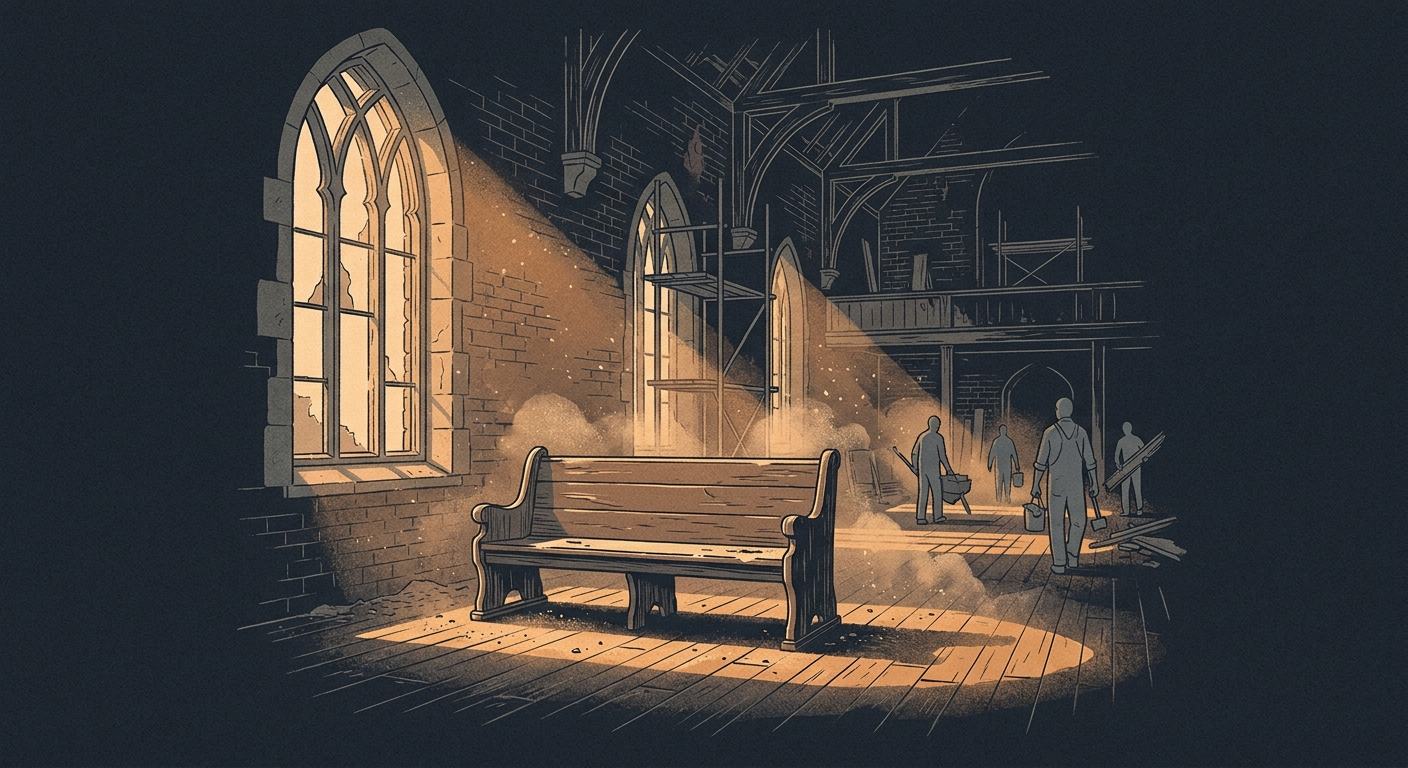
Antioch Missionary Baptist Church, at 525 N. Church St., was built in 1890 and housed one of Decatur's largest Black congregations from 1957 until the church moved out years ago. By Monday night the stained-glass windows were gone and cranes sat behind the building.
Jacob K. Robinson, whose family worshipped there, told the council he'd walked into the unlocked building the week before and filmed for 45 minutes. His Facebook video drew more than 10,000 responses in two days. "Four people voted to tear that church down," he said. "You're being watched." Jeffrey Perkins, 73, who was baptized there and walked his sister down its aisle, put it in broader terms: a "value gap" in which Black neighborhoods and institutions are treated as worth less.
The city's explanation, delivered by corporation counsel Wendy Morthland, is procedural but important. The council authorized a demolition filing back in April 2024. A would-be buyer surfaced, so the city paused. The deal collapsed. A state-mandated asbestos inspector then found the building too unsafe to even remove asbestos from the inside, and a structural engineer declared it unsound. Both reports went to the Illinois EPA before a permit was issued. The building has had at least three owners since the congregation left; twice it was sold by the county trustee for unpaid property taxes.
And here's the part that surprised even some council members: the city is paying for the demolition but owns nothing. State law lets a city tear down a dangerous, abandoned building; it does not transfer the pews, organs or chandeliers inside. When Council member Dennis Cooper asked where all that went, no one could say.
Horn's remark was the sharpest break from the dais. He noted the city has roughly 500 vacant properties that can't be saved, and argued Antioch didn't need to be first in line. He also pointed out that when the city itself owned the old We Folks Home, it wrapped the building in protective barriers far better than plywood — a courtesy it has no policy to extend to privately owned historic buildings. Council member Patrick McDaniel offered the counterweight: "You can't save everything. You gotta put money into it." Preservationist Anne Owens, who had been trying to find Antioch a new owner since 1999, agreed no one with means ever stepped forward.
Jargon decoder: demolition
 AI illustration
- Why can the city demolish a building it doesn't own?
Illinois law lets municipalities demolish structures that are either "dangerous and unsafe" or "open and abandoned." The city places a lien on the land to recover costs, but it doesn't become the owner unless it later forecloses — by which time the building is gone.
- County trustee sale
When property taxes go unpaid for years, the county trustee can sell the parcel — often for a few hundred dollars — to anyone willing to take on the back taxes. It's how many of Decatur's vacant buildings end up with distant or inattentive owners.
- Demolition list vs. code violations
Two separate legal tracks. A building that's dangerous and abandoned goes to demolition. A building that's occupied but in poor shape gets property-maintenance citations, which can take 120 days or more to work through administrative and circuit court.
A month without Oasis
Heritage Behavioral Health closed the Oasis Day Center about four weeks ago, with no transition plan. Outreach volunteer Jeffrey Mueller said the 25 to 40 people he meets each night are still outside, and winter is coming. "This is not a Heritage problem. This is not an Oasis problem any longer. This remains a people problem."
Mayor Julie Moore Wolfe was candid: the city is pricing out laundry and shower facilities, which would need an enclosed building and a future council vote. She has asked whether another organization could simply take over the fully-equipped Oasis building; several have said "maybe," but none has funding or trained staff. The Continuum of Care — the regional coalition that coordinates homeless services — may be able to run it half-days for several weeks as a stopgap. "It's a crisis," she said. "It's going to take more time than any of us would like."
McDaniel aimed his frustration at Heritage's board for closing "overnight" and leaving the community to scramble. No one from Heritage spoke.
Where people are living now
Dominique Stanton, a Greenwood Manor tenant, said she reported roaches, mice, bedbugs and black mold — and received an eviction notice in return. She'll be homeless with her child on Nov. 1 if nothing changes. Council member Consuelo Cruz pressed staff on the city's largest troubled complex, Wabash Crossing, and got a series of answers residents should note:
About half of Wabash Crossing is currently unlivable, by the mayor's own estimate. The city does not want it torn down — demolition would erase scarce low-income housing — and is meeting with the private owner, HUD and the Decatur Housing Authority to push for rehab instead. The roughly 70 code violations issued there in March went to administrative court, the owner was found in violation, and the case has likely moved to circuit court. Cruz asked for a written status at the next meeting.
For Greenwood tenants, the answer was more frustrating: the city says it cannot inspect inside apartments until residents contact Neighborhood Standards directly, so inspectors can gain entry or get an administrative warrant. Horn called this back-and-forth "literally weeks" of delay.
Jargon decoder: housing
 AI illustration
- HOPE VI
A 1990s federal program that replaced old public-housing towers with mixed-income developments run by private owners. Wabash Crossing was one. That's why the city neither owns the land nor holds a lease — and why fixing it requires negotiating with a private company and HUD.
- Continuum of Care
The HUD-required local coalition of agencies that coordinates homeless services and competes for federal homeless-assistance dollars. It's a planning body, not a landlord — which is why it can offer to "run Oasis half-days" but not fund it long-term.
- Vacant Property Registration
A 2020 ordinance requiring owners of vacant or foreclosed buildings to register, pay a fee, and submit to inspections. Horn said staff called it the city's top proactive tool when it passed. Five years later, about 25 properties are registered against an estimated 5,000 vacant homes. Staff admitted Monday they are now reviewing whether it does anything existing code enforcement doesn't.
The business of the evening
After an hour of this, the votes came fast. For a reader with a stake in Decatur's economy, three deserve attention.
Water. The city will pay the University of Illinois' State Water Survey to determine how much the Mahomet Aquifer wells in DeWitt County can sustainably yield. A 2001 study put the figure at 7.5 million gallons a day; in droughts the city has pulled 10 to 12 million for a month or three. For any industry considering Decatur — including the data centers now in local conversation — this number is the one that matters. No new infrastructure or permits are required.
Transit. Staff will apply to the Illinois Department of Transportation for roughly $20 million toward the Transit Campus Master Plan. The former Tommy House Tire building on the site has just been cleared.
TIFs. Four of the six resolutions concerned two proposed tax-increment-financing districts: "Near North 2," which would succeed the expiring district covering Wabash Crossing, and a new one around Pershing Road and 22nd Street. Monday's votes only hire PGAV Planners to study whether the areas qualify — not to create the districts. Horn supported the studies but challenged staff to show residents a TIF that fixes roofs, not just storefronts. Resident Chad Bolen went further, noting the city's 2023–2025 strategic plan set five measurable revitalization goals, has now expired, and no scorecard has ever been published. "Show the cost. Show the effect. Show the change."
Jargon decoder: TIF, in one paragraph
 AI illustration
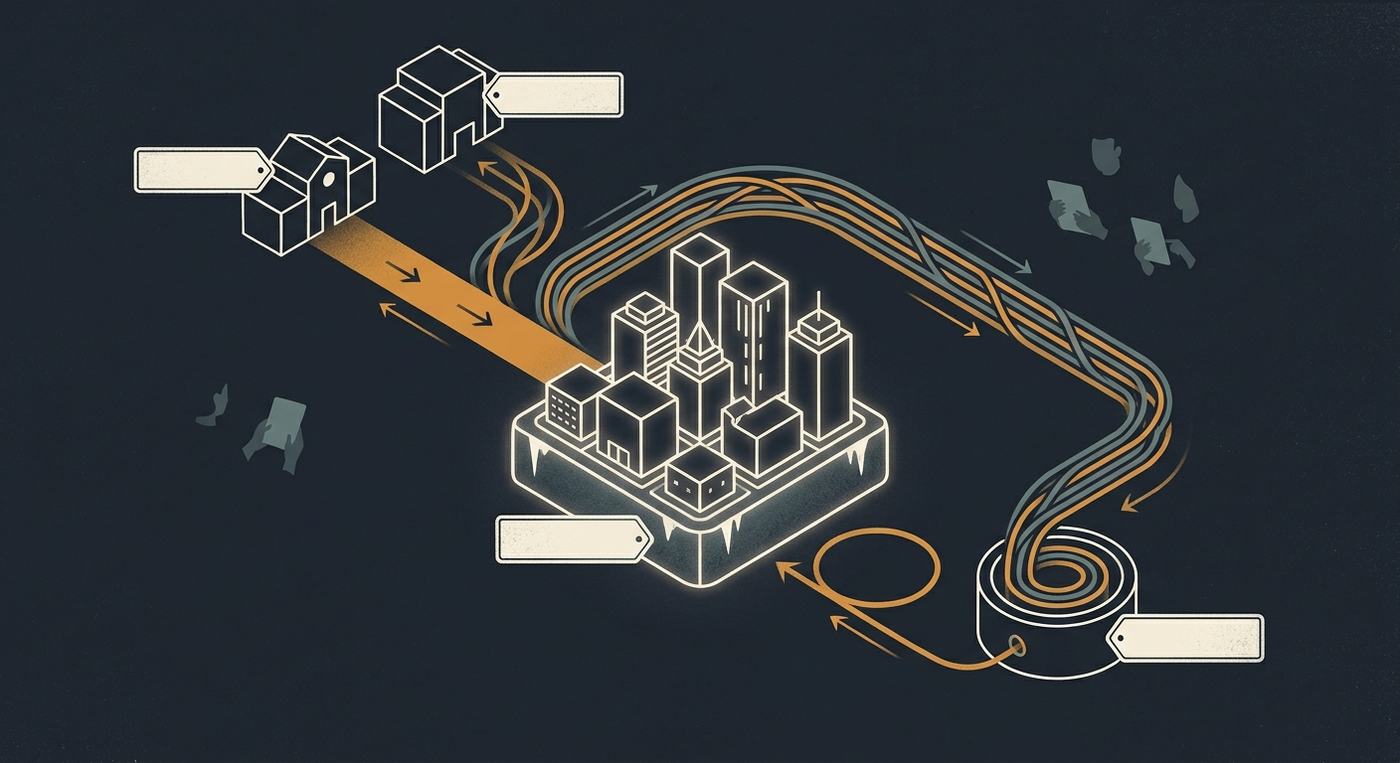
A Tax Increment Financing district freezes the property-tax base in a defined area for up to 23 years. Taxes on the frozen value keep flowing to schools and the county as before; taxes on any growth in value — the "increment" — go into a city fund that can only be spent inside the district on things like infrastructure, demolition, developer incentives or, if the council chooses, homeowner repair grants. Supporters say it's the only tool that attracts developers who would otherwise go to the next town. Critics say schools lose future revenue and the money too often goes to businesses rather than residents. A feasibility study is the legally required first step: a consultant must certify the area is "blighted" or "conservation" eligible before a district can exist.
Also approved without discussion: rezoning five storefronts on West Main Street from office to commercial so a new tea shop, Spill & Tea Company, can open downtown; annexing 2010 Heritage Drive; accepting a FEMA grant for diesel-exhaust systems at fire stations; a slate of board appointments; and a correction to an event-space permit at 357 W. Decatur St. whose parcel number had been typed wrong two weeks earlier. The council also released closed-session minutes from April 26, May 19 and June 20 — a state-required review it conducts every six months.
By the numbers
What it means
Three threads run through all of this. First, Decatur's housing problem is now a homelessness problem, and the two are feeding each other: unlivable units at Wabash, retaliation complaints at Greenwood, a closed day center, and affordable stock shrinking by roughly 20 units a year. Second, the city's tools are mismatched to the moment. Its flagship vacant-property law has a 0.5% registration rate; its inspection process requires frightened tenants to make the first call; and its demolition authority can erase a landmark but can't save a piano. Third, the council knows it. Horn said the quiet part aloud: a data-center ordinance is more likely to reach the council before an affordable-housing one. Whether that changes is what the next quarter will tell.
The Accountability Ledger
Commitments and open questions, tracked quarterly. Next review: mid-January 2027. Meters advance only on documented action — a vote, a published report, a staff answer on the record.
| Item | Who | Promised | Status | Progress | Age |
|---|---|---|---|---|---|
| Written status of ~70 Wabash Crossing code violations | City Manager Hahn | Next meeting (Nov. 2) | Open | new | |
| Was Antioch ever on the vacant-property registry? | Econ. & Community Dev. | Next meeting | Open | new | |
| Where did Antioch's interior contents go? | Unassigned | No date | Unanswered | new | |
| Review of Vacant Property Registration ordinance — keep, fix or repeal | Corporation Counsel / staff | "Started today" | Open | new | |
| Cost estimate for laundry/shower facilities for unhoused residents | Mayor / staff | Return to council | Open | new | |
| Interim operator for Oasis building (Continuum of Care half-days) | Mayor / CoC | Weeks | Pending | new | |
| Near North 2 TIF feasibility study | PGAV Planners | Months | Authorized | new | |
| Pershing/22nd TIF feasibility study | PGAV Planners | Months | Authorized | new | |
| Mahomet Aquifer sustainable-yield study | Illinois State Water Survey | Not stated | Authorized | new | |
| $20M IDOT transit grant application | Econ. & Community Dev. | Submission TBD | Authorized | new | |
| 2023–25 Strategic Plan scorecard (resident request) | Unassigned | No commitment | Unanswered | new | |
| Zoning changes for ADUs, tiny homes, prefab (Horn) | Council | None | No action | new |
How to read The Breakdown
Same meeting, same sources, same ledger — told the way you'd explain it to a neighbor over coffee. Analogies are for understanding, not persuasion; where something is unresolved, we say so.
Picture a family meeting that runs an hour and twenty minutes. For the first hour, everyone who's upset gets three minutes to say so, and the rule is the people at the head of the table have to sit and listen. Then, in the last twenty minutes, the head of the table runs through a to-do list and everyone nods. That was Monday night at Decatur City Council. The to-do list was real and it passed 6–0 every time. But the first hour is where the city was being asked the hard questions — and most of them are still open.
Here's the whole thing in plain terms, one issue at a time. Every fact below comes from the meeting video and transcript, the city's own agenda documents, or the city's roster. Where something hasn't been answered, we say so instead of guessing.
The church: how a city can pay to tear down a building it doesn't own
Antioch Missionary Baptist Church at 525 N. Church St. was built in 1890. By Monday, the stained glass was already out and the cranes were parked. Several people who grew up in that church came to say they felt it had been treated as worth less than other buildings. One, Jacob K. Robinson, said "four people voted to tear that church down."
The record shows it differently, and the difference matters. The city's own memo from April 1, 2024 lists 525 N. Church as the first of twenty "unsafe structures" sent toward demolition, noting it was posted Unfit for Human Habitation in September 2023. The vote that night was 7–0 — every council member, including the mayor. Nobody voted no.
So how does a city demolish something it doesn't own? Think of it like a neighbor's dead tree leaning over your fence. You can't make them cut it down for being ugly — but if it's about to fall on someone, the law lets the city step in, remove the hazard, and put the bill on the property as a lien. That's exactly the two-step the city used: declare it unsafe, then ask a court to allow demolition. What the city does not get is the stuff inside. The pews, the organ, the chandeliers — those belonged to whoever owned the building. When Council member Dennis Cooper asked where all of it went, nobody at the table could say. That question is on the ledger.
Horn's point was about priorities, not legality. The city estimates about 500 vacant buildings are too far gone to save; he argued Antioch didn't need to be at the front of that line. Council member Patrick McDaniel pushed back: "You can't save everything. You gotta put money into it." Both things can be true, and the transcript shows the council has known about this building for a long time — in April 2024 the then-city manager called it "just a matter of time" and said the owner, an out-of-state LLC, would never have assets to pay for its own demolition.
Jargon decoder: demolition, in plain English
AI illustration
- Dangerous / abandoned
Illinois lets a city tear down a building that's either unsafe or open-and-abandoned. The city puts a lien on the land for the cost, but doesn't become the owner.
- County trustee sale
When nobody pays the property taxes for years, the county sells the parcel — often for a few hundred dollars — to whoever will take on the back taxes. Antioch went through this twice. It's how so many of Decatur's empty buildings end up owned by people far away.
- Two different tracks
An empty, dangerous building goes down the demolition track. An occupied building in bad shape goes down the citation-and-court track, which can take 120 days or more. Same city, two very different clocks.
The registry nobody uses: a smoke detector with no battery
Resident Jennifer Rosenberger found the ordinance herself: Chapter 70.2, passed May 18, 2020, says any owner of a vacant building in Decatur has to register it within fifteen days, pay $200, and keep paying $350 every six months. The idea was simple — the city would know who owns every empty building and could reach them before it collapsed. Staff said at the time it was the single most proactive tool the council could adopt.
Five years later, about 25 properties are registered. The city estimates up to 5,000 vacant homes. That's a half of one percent. The law is a smoke detector that was installed and never had a battery put in. Staff acknowledged Monday they're now reviewing whether the ordinance does anything the regular code-enforcement process doesn't.
Was Antioch ever on that registry? Under the ordinance, its owner was required to be. The city hasn't said. The registry itself has never been published. That's on the ledger as a question for the Economic & Community Development department.
A month without Oasis
Heritage Behavioral Health closed the Oasis Day Center about four weeks before this meeting, with no handoff. An outreach volunteer, Jeffrey Mueller, told the council the 25 to 40 people he meets each night are still outside, and the weather is turning. "This remains a people problem."
The mayor was direct about where things stand. The city is pricing out laundry and shower facilities, which would need an enclosed building and a future vote. She has asked other organizations to take over the fully-equipped Oasis building — several said "maybe," none has funding or trained staff. The Continuum of Care, the regional coalition that coordinates homeless services, may be able to run it half-days for a few weeks as a stopgap. Think of the Continuum of Care as the dispatcher, not the ambulance: it coordinates agencies and competes for federal dollars, but it doesn't own buildings or employ shelter staff. That's why it can offer hours but not a solution.
Where people are living: Wabash Crossing and Greenwood Manor
A Greenwood Manor tenant, Dominique Stanton, said she reported roaches, mice, bedbugs and black mold — and got an eviction notice back, effective Nov. 1. The city's answer was procedural: inspectors can't enter an apartment until the tenant contacts Neighborhood Standards directly, so they can get permission or a warrant. Horn called the back-and-forth "literally weeks" of delay. We're reporting Ms. Stanton's account as what she told the council; the city hasn't responded on the record.
Wabash Crossing is the bigger picture. The mayor's own estimate is that about half of it is currently unlivable. Here's the piece that's easy to miss: the city doesn't want it demolished, because that would erase scarce low-income housing. It's trying to push the private owner, HUD and the Housing Authority toward rehab instead. The roughly 70 code violations issued in March went to administrative court, the owner was found in violation, and the case is likely headed to circuit court. Council member Consuelo Cruz asked for a written status at the next meeting — that's a ledger item with a Nov. 2 date on it.
Jargon decoder: housing
AI illustration
Why can't the city just fix Wabash Crossing? Because of how it was built.
- HOPE VI
A 1990s federal program that replaced old public-housing towers with mixed-income complexes run by private owners. Wabash Crossing is one. The city is a referee here, not the landlord — it can cite, but it can't repair.
- Continuum of Care
The HUD-required local coalition that coordinates homeless services. A planning table, not a shelter operator.
- Vacant Property Registration
The 2020 ordinance above. 25 registered out of an estimated 5,000 vacant. Under review by staff as of Monday.
The twenty minutes of yes votes
Then the formal agenda, which moved fast. Three items matter if you live or do business here.
Water. The city will pay the Illinois State Water Survey to figure out how much the Mahomet Aquifer wells in DeWitt County can safely pump, long-term. A 2001 study said 7.5 million gallons a day; in droughts the city has pulled 10 to 12 million for a month or more. Think of it as finally getting the aquifer's actual credit limit instead of guessing. Any big employer looking at Decatur — including the data centers people are talking about — will want that number.
Transit. Staff will ask IDOT for roughly $20 million toward the Transit Campus Master Plan. The old Tommy House Tire building on the site was just cleared.
TIFs. Four of six resolutions were about two proposed tax-increment-financing districts: "Near North 2," replacing the expiring one that covers Wabash Crossing, and a new one around Pershing Road and 22nd Street. Monday's votes hire a consultant, PGAV Planners, to study whether the areas qualify. They do not create the districts.
Jargon decoder: TIF
AI illustration
The simplest way to think about a TIF: the city draws a line around a neighborhood and takes a snapshot of its property-tax value today.
- The snapshot
Taxes on today's value keep going where they always went — schools, county, parks. Nothing is taken from them.
- The increment
If values inside the line go up, the extra tax from that growth goes into a special fund for up to 23 years, spendable only inside the line — on infrastructure, demolition, developer incentives, or, if the council chooses, homeowner repair grants.
- The catch
Schools and the county don't share in the growth for those 23 years. Supporters say the growth wouldn't have happened without the TIF. Critics say the money too often goes to storefronts, not residents. Horn asked staff to show residents a TIF that fixes roofs.
- Feasibility study
The legally required first step: a consultant has to certify the area is "blighted" or "conservation" eligible before a district can exist. That's what was approved Monday.
The scorecard question
Resident Chad Bolen asked a question we think deserves its own section, because it's about the city grading its own homework. The council's 2023–2025 Strategic Plan — adopted January 16, 2024 — says neighborhood revitalization would be measured by five numbers: property values, housing condition, vacant lots, crime, and owner-occupancy, each by neighborhood. Bolen asked: where are the before-and-after numbers? Where's the baseline, the target, the dashboard?
We went and read the plan and its attachments. The five measures are there. Baselines, targets and deadlines are not. The city manager's cover memo called the companion "performance outcomes" document "an organic document" to be "populated with data in the future." At the August 2023 planning retreat, the city's Chief Data Officer showed the council a dashboard built to track these outcomes. We could find no instance of that dashboard, or any progress report on the plan, appearing on a council agenda from adoption through Monday night. The plan expired December 31, 2025. The council moved to the next vote without responding. It's on the ledger as Unanswered.
By the numbers
What it means
Pull the threads together and three things are clear from the record. First, Decatur's housing problem and its homelessness problem are now the same problem — unlivable units at Wabash, retaliation complaints at Greenwood, a closed day center, and roughly 20 affordable units lost each year. Second, the city's tools don't match the moment: a registry with a 0.5% uptake, an inspection process that needs frightened tenants to make the first call, and a demolition authority that can remove a landmark but can't account for a pew. Third, the council said so itself — Horn noted a data-center ordinance will likely reach the council before an affordable-housing one. Whether that order changes is what the ledger below will track, meeting by meeting.
The Accountability Ledger
Commitments and open questions, tracked quarterly. Next review: mid-January 2027. Meters advance only on documented action — a vote, a published report, a staff answer on the record.
| Item | Who | Promised | Status | Progress | Age |
|---|---|---|---|---|---|
| Written status of ~70 Wabash Crossing code violations | City Manager Hahn | Next meeting (Nov. 2) | Open | new | |
| Was Antioch ever on the vacant-property registry? | Econ. & Community Dev. | Next meeting | Open | new | |
| Where did Antioch's interior contents go? | Unassigned | No date | Unanswered | new | |
| Review of Vacant Property Registration ordinance — keep, fix or repeal | Corporation Counsel / staff | "Started today" | Open | new | |
| Cost estimate for laundry/shower facilities for unhoused residents | Mayor / staff | Return to council | Open | new | |
| Interim operator for Oasis building (Continuum of Care half-days) | Mayor / CoC | Weeks | Pending | new | |
| Near North 2 TIF feasibility study | PGAV Planners | Months | Authorized | new | |
| Pershing/22nd TIF feasibility study | PGAV Planners | Months | Authorized | new | |
| Mahomet Aquifer sustainable-yield study | Illinois State Water Survey | Not stated | Authorized | new | |
| $20M IDOT transit grant application | Econ. & Community Dev. | Submission TBD | Authorized | new | |
| 2023–25 Strategic Plan scorecard (resident request) | Unassigned | No commitment | Unanswered | new | |
| Zoning changes for ADUs, tiny homes, prefab (Horn) | Council | None | No action | new |